

.png)
.png)
Turning Trash into Treasure
It was the summer of 2022. Daniel, my then boyfriend and now fiancé, got a new job working with Atlantic Healthy Oceans Initiative (AHOI), a non-profit that worked to clean garbage and debris from beaches and shorelines in Gros Morne. I went to a cleanup with him at Wild Cove, a beach we often visit for campfires, paddleboarding, and sunset watching. We spent over three hours collecting, sorting, and counting garbage. I remember finding a balloon and ribbon tied around bones and some feathers, and also counted over 1000 shotgun shells.

If you were to ask me back then, I probably wouldn’t have said it made a big impact on me. But when I went back to school in Halifax, I created a series of prints about those cleanups for my first project in Intro to Screenprinting. Then I made a series of oil pastel drawings of garbage. Next, I conducted a beach cleanup at a beach in the Bay of Fundy and used what I had collected to make a series of prints. In the final year of my degree, I took two garbage bags full of shotgun shells collected from the beaches of Gros Morne by AHOI and transformed them into a coral wall inspired by Gadd’s Wall, an infamous dive site home to an abundance of cold water coral, sponges, and other marine species. Ocean waste was no longer just debris to me; it had become my material, my matrix, and my muse.

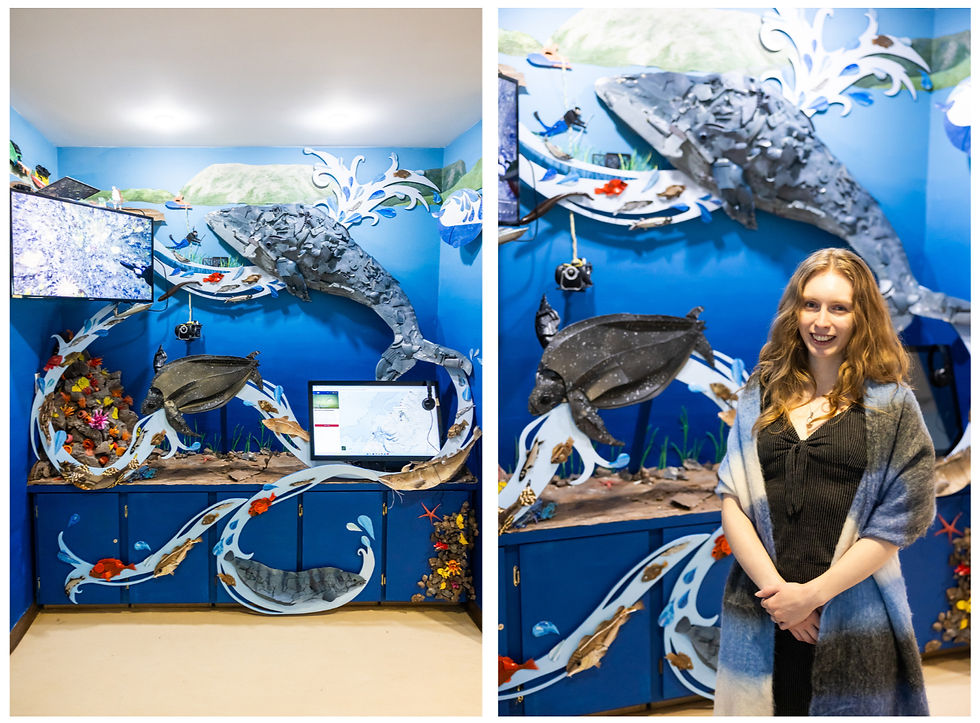
In 2025, after my debut solo exhibition, In Our Waters, which featured the coral wall covered in shotgun shells and prints made from ocean waste, AHOI approached me with the idea of making an educational art installation for the Bonne Bay Aquarium and Research Station in Norris Point. The goal was to build a piece entirely from beach garbage that would showcase Bonne Bay, the creatures in it - especially aquatic species at risk - and the broader work AHOI is doing in the region, from research and monitoring to plastic pollution reduction. That summer, from May to August, I volunteered whenever I could, collecting and auditing debris that would eventually become part of the installation.

In September, once all the garbage was collected, I got to work. The first step was cleaning it, which was a slow and boring process, but one that allowed me to become familiar with exactly what I had to work with. When everything was dry, I brought it inside and sorted it, setting aside the pieces that sparked ideas.
One of the first things I made was a blue lobster, which are exceptionally rare, with a roughly 1-in-2-million chance of appearing due to a genetic mutation. I had a melted piece of plastic, likely part of a recycling bag that had been half burned in a fire, and I thought it would make a great blue claw. I gathered all of my blue pieces and made a lobster from them. I made an Acadian redfish using the same approach, trying to use materials that were already red. I followed that idea for a capelin and a cunner, but it quickly became clear that I was going to have to paint some of the pieces. Painting became especially necessary for larger species like the blue whale, as well as the leatherback sea turtle and Atlantic cod.

Once we had settled on a design for the wall, I really got to work. I had a list of species to create: Atlantic wolffish, leatherback sea turtle, sculpin (who I’m just a fan of), white hake, thorny skate, and Atlantic cod. Many of these species are considered Aquatic Species at Risk in our region, and including them was a way to highlight the biodiversity of Bonne Bay.

My process for making each fish started with a drawing. I used the drawing as a template while searching through hundreds of plastic fragments and layering them together in that shape. Some pieces are cut down to size, but I preferred finding pieces that matched the curves of the fish. As my collection of materials shrank, that became much more challenging. When a fish was fully assembled, I took it outside to spray paint it. This was easy enough in September and October, but by December, I was painting the whale in the snow. Spray paint created the base colour, and then I added details, like spots, splotches, and scales, by hand. I wanted each piece to function as part of a larger composition, but also to be recognizable immediately by someone familiar with the species. Once I was satisfied, each piece received a clear coat of spray paint to protect it from scratches and give it that fishy sheen.

The whale was the final and largest piece I created. I left it for last so I could use everything I learned from making the other species. It began as a 6-foot drawing spread across the floor of my studio and was built in 8 sections so it could be transported from Corner Brook to Norris Point. Because of its scale, I was able to incorporate bigger and more recognizable objects, such as bait boxes, a toy wrench, a pill bottle, a McDonald’s toy, and even a Kinder egg container. I added barnacles carefully removed from a plastic lid, paying attention to small details that make the whale recognizable as a blue whale.

Shortly before Christmas, I took everything up to Norris Point for installation. Putting everything together took longer than expected, and even painting the gradient on the wall took me a full day. With help from Ryan Decker at the Marine Station, we installed the pieces over several days. The whale was the trickiest part, because of its size and rounded body. We had to carefully secure each section and conceal the hardware beneath fish, water droplets and other elements. I returned twice more to add finishing touches until the wall felt complete.

What makes this wall different from other pieces is the two digital screens embedded within it that bring AHOI’s scientific research directly into the artwork. One features research and underwater footage captured by the ROV in Bonne Bay, and the other hosts AHOI’s interactive map. The map shares stories and information about Aquatic Species at Risk and research being done to protect them, along with historic research and community stories. I love that the piece doesn’t just represent these species, it also gives visitors a chance to learn about them through data, research, and community stewardship efforts. I think it’s the perfect intersection of art and science!
I can’t wait for the Marine Station to open this summer and to see how people, especially kids, respond. I hope the installation inspires people to get involved in their community and to engage with ocean plastics as a local issue that they can help tackle. In a world where I can buy any material I want, I choose to work with garbage. It’s a creative choice, but also a commitment. In every facet of my life, I try to reuse and reclaim discarded materials, because even if it won’t solve the problem of overproduction and the amount of garbage created every day, it gives me peace of mind to live and create sustainably.


Comments